

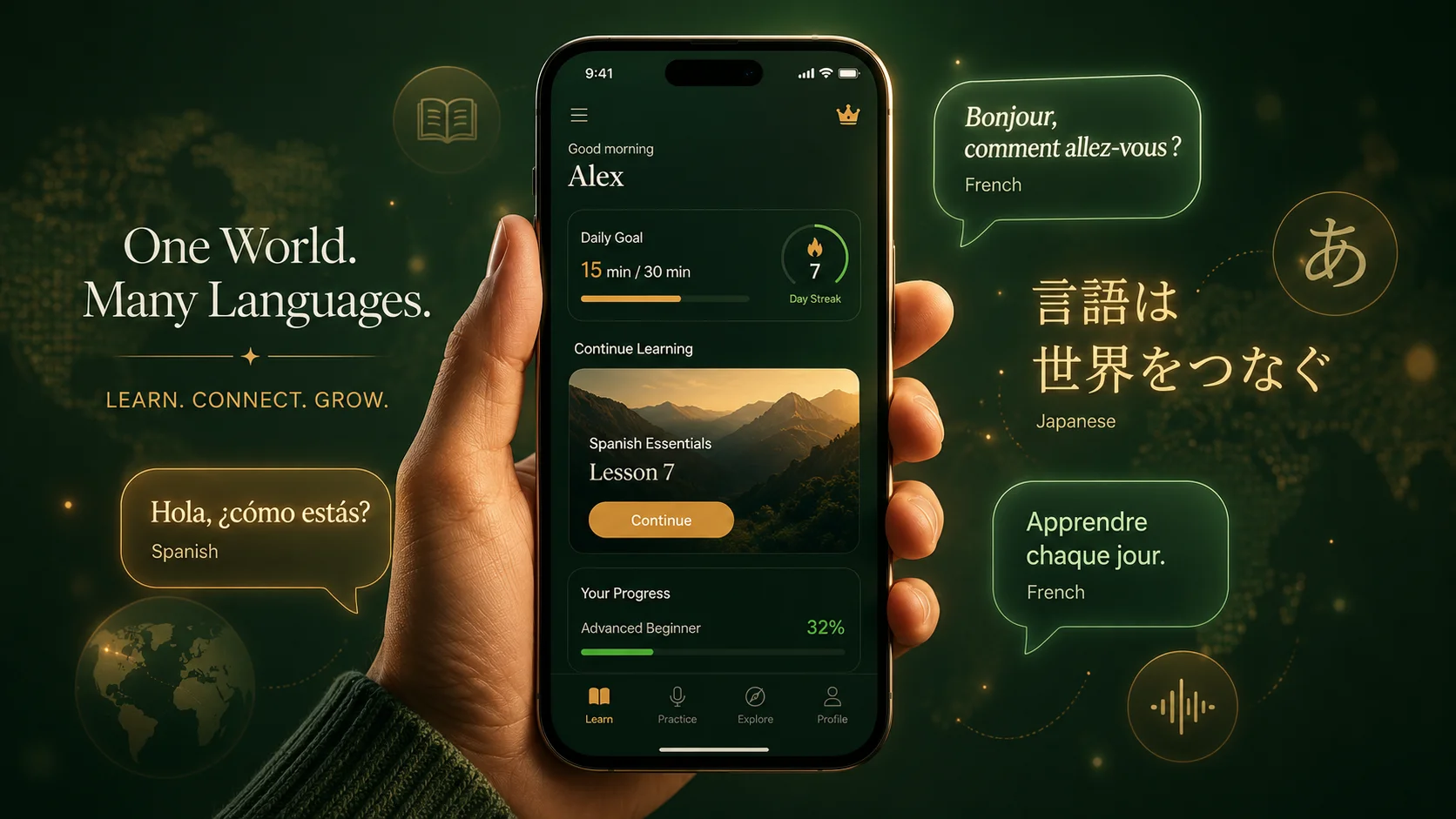
I've been learning Spanish on and off for six years. Formally for two, then sporadic apps, then forgetting half of it, then trying again. When I say I've tested ai language learning tools, I mean I've tested them as someone who genuinely needed them — not as a reviewer going through a checklist. That experience changes what I look for. I don't care about the gamification streak mechanics or the cheerful animations. I care about whether I can hold a conversation after three months of consistent use.
The honest answer in 2026 is that AI has genuinely changed what's possible in language learning — but not in the way most of the marketing suggests. AI hasn't solved the hard part of language acquisition. What it has done is dramatically lower the cost of the practice you need. And practice is the variable that actually determines whether you learn a language or not.
What AI Actually Changes About Language Learning (and What It Doesn't)
Language acquisition research has been fairly consistent for decades: you need comprehensible input (reading and listening to material that's just above your current level), output practice (actually speaking and writing), and feedback that's fast enough to correct you before errors become habits. Traditional language learning apps like the original Duolingo were good at input, terrible at output practice, and had essentially no real feedback loop.
AI changes the output and feedback part dramatically. A conversational AI can respond to your Spanish at 2am, never gets impatient when you make the same subjunctive mistake for the fourteenth time, and can explain why something is wrong in terms calibrated to your level. That's genuinely revolutionary for learners who don't have access to tutors or immersive environments. What AI still can't do: give you the cultural intuition that comes from living in a place, replicate the social stakes that make conversation practice feel real, or replace the intrinsic motivation you need to keep going when it gets hard. AI is a very good practice partner. It is not a shortcut to fluency.
With that framing established, here are the tools that are actually delivering on the promise of ai language learning in 2026.
Duolingo Max: The Subscription Upgrade Worth Considering
Duolingo's free tier is still the most accessible entry point into language learning on the planet — 40+ languages, well-structured curricula, and more active users than any other language app by a significant margin. But Duolingo Max, their premium tier at around $13.99/month (or $84/year), added two AI features that meaningfully change what the app can do: Roleplay and Explain My Answer.
Roleplay is exactly what it sounds like — you have a conversation with an AI character in a real-world scenario (ordering at a café, checking into a hotel, apologizing to a neighbor for a noise complaint). The AI adapts to your level, you respond by typing or speaking, and it keeps the scene moving naturally. This kind of contextual conversation practice used to require a language exchange partner or a tutor. Now it's available at any hour, infinitely patient. The scenarios aren't always thrilling, but they're realistic, and realism is what matters for actual retention.
Explain My Answer is subtler but arguably more valuable for intermediate learners. When you get something wrong, instead of just showing you the correct answer, the AI explains the grammatical or semantic reason you were wrong — in your native language. For the kinds of confusions that persist for months (ser vs. estar in Spanish, for instance, or the difference between German dative and accusative prepositions), getting a clear, contextual explanation the moment you make the error is genuinely more effective than looking it up later. If you're already on Duolingo regularly, the Max upgrade is worth it. If you're a complete beginner unsure whether language learning will stick, start with the free tier first.
Speak App: AI Conversation Partner That Doesn't Judge You
The reason most language learners never reach conversational fluency isn't lack of vocabulary — it's fear of speaking. Speaking a foreign language in front of a native speaker is nerve-wracking. You freeze, you forget words you definitely know, you mispronounce things and feel embarrassed. Speak, an app focused entirely on spoken output practice, exists to solve exactly this problem.
Speak's core feature is an AI tutor that listens to you speak in your target language and responds conversationally. It's available for Korean, Japanese, French, German, Spanish, English, and a few others. The AI doesn't just evaluate your pronunciation with a score — it actually engages with what you said, asks follow-up questions, and corrects you mid-conversation in a way that feels natural rather than clinical. The free tier gives you limited daily lessons; the full subscription runs about $12.99/month and unlocks unlimited conversation practice.
What sets Speak apart from just talking to ChatGPT is the pedagogical structure. Speak knows you're a learner. It introduces vocabulary in context, it recycles phrases from previous sessions, and its feedback is calibrated to not overwhelm you. Talking to an AI language tutor via ChatGPT is possible and I'll describe how in the next section — but for pure spoken output practice with someone (something) that's been designed specifically for that use case, Speak is currently the best option on the market. The embarrassment barrier really does disappear fast. After a week of daily sessions, most learners report that real conversations become noticeably less scary.
ChatGPT as a Language Tutor: How I Actually Use It
ChatGPT is not a dedicated language learning app, but with the right approach it can be one of the most flexible ai language tutor tools available — particularly for intermediate and advanced learners who have specific gaps to fill. Here are the specific prompts and workflows I actually use.
For grammar explanation: "I'm an intermediate Spanish learner. Explain the difference between 'por' and 'para' with three examples of each in realistic sentences, then give me five practice sentences and wait for me to fill in the blank before telling me the answer." This works better than most grammar books because it's interactive and it adapts to follow-up questions. If the first explanation doesn't click, you can say "try explaining it a different way" and it will.
For conversation practice via text: "Let's have a conversation in French. I'm B1 level. You play a friend I'm catching up with after a summer apart. Correct any significant errors I make after each of my messages, in English, before continuing the conversation in French." This gives you the output practice with embedded feedback without requiring a human partner. For vocabulary building: "I'm learning Italian. Give me the 20 most useful words for discussing food and cooking at a B1 level. For each word give me the Italian, a phonetic guide, an example sentence, and a common mistake learners make with this word." The specificity of the request is what determines the quality of the output. Vague prompts produce generic language-app content; specific prompts produce genuinely useful learning material.
Babbel vs. Pimsleur vs. the Newer AI Tools: Quick Comparison
Since people ask constantly, here's an honest side-by-side of the established players and how they compare in 2026. Babbel ($13.95/month or $83.40/year) remains one of the most pedagogically solid options for European languages. It was built by actual linguists, the grammar explanations are clearer than Duolingo's, and the lesson structure is more coherent. Babbel doesn't have the same AI-powered conversation features as the newer tools, but its foundational curriculum for Spanish, French, German, Italian, and Portuguese is excellent. If you want structure over flexibility, Babbel is still a strong choice.
Pimsleur ($14.95/month) takes a completely different approach: it's entirely audio-based, using spaced repetition to build spoken vocabulary through listening and repeating. There's no screen to stare at, which makes it ideal for commutes or exercise. Pimsleur's method produces genuinely good pronunciation and listening comprehension, but it's slow and linear — you can't skip ahead or customize your path. Pimsleur added some AI conversation practice features in 2025, but they feel like additions to an audio course rather than a native AI experience.
Where do the newer, more AI-native tools fit? Apps like Langua, Ling, and ELSA Speak (pronunciation-focused) are filling niches that older platforms left open. ELSA Speak in particular — focused purely on English pronunciation for non-native speakers — is exceptional at what it does, using AI to give phoneme-level feedback that no human tutor can match for price. If pronunciation is your specific bottleneck, ELSA Speak at around $11.99/month is a more targeted investment than any general language app.
The Honest Verdict: AI Is a Practice Partner, Not a Shortcut
After all of this testing, my recommendation for someone serious about learning a language with ai in 2026 comes down to one core principle: use AI to maximize the time you spend producing the language, not just consuming explanations about it. The research on language acquisition is clear — output practice, not passive input, is what drives fluency. AI tools are now the best and cheapest way to get massive amounts of output practice.
The stack I'd build: Duolingo Free or Max for daily structured vocabulary and grammar input (20 minutes/day consistently beats 2 hours once a week). Speak or a well-prompted ChatGPT session for spoken or written conversation practice (3-4 times per week, 15-20 minutes). For specific grammar gaps, ChatGPT with focused prompts. For pronunciation, ELSA Speak if English or a dedicated pronunciation module if another language. That combination — structured input, AI conversation practice, targeted grammar work — covers everything that used to require a classroom or a tutor. The tools are genuinely good. The question, as always, is whether you'll use them consistently enough for the language to stick.