

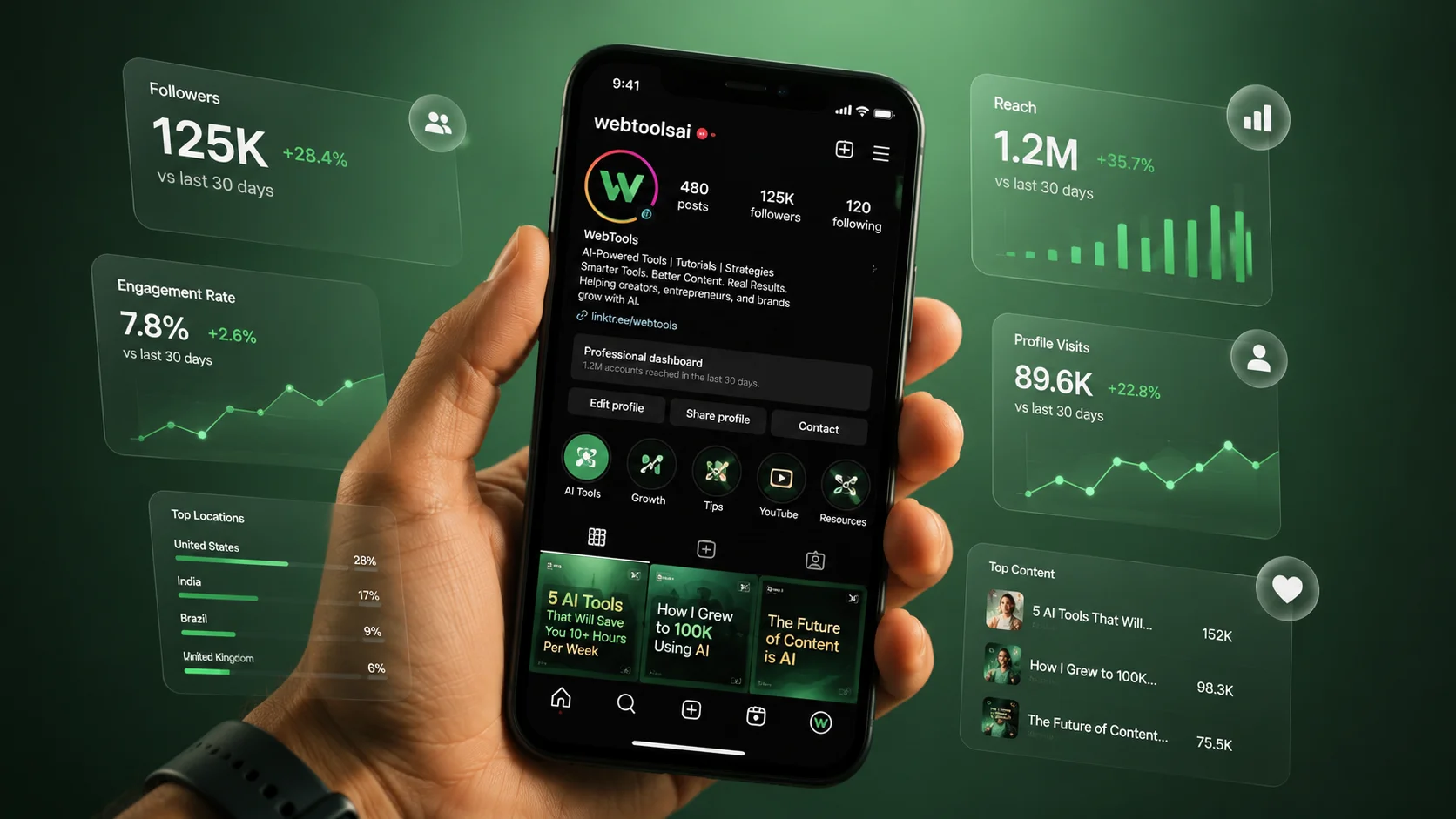
Growing on Instagram in 2026 is genuinely harder than it was in 2022. The algorithm has matured, the platform is more saturated, and casual posting no longer builds a following the way it once did. I've been testing AI tools for social growth for most of this year — and I want to give you an honest read on what actually moves the needle and what's just noise.
The good news is that AI has made specific parts of the growth process meaningfully easier: generating consistent content, testing more caption variations, and making data-driven decisions about posting times and formats. The bad news is that AI can't manufacture community, and it can't shortcut the fundamental requirement of posting content people genuinely want to see. With that calibration in place, let's get into the tools.
Why Instagram Growth Is Harder in 2026 — and Where AI Genuinely Helps
Instagram's 2025 algorithm update doubled down on something the platform has been moving toward for years: ranking content by how long it holds attention, not just how quickly it racks up likes. That means your first three seconds of a Reel — and your caption's first line — matter more than ever. Hook quality has always been important, but now it's the primary variable separating accounts that grow from accounts that stall.
The algorithm also weights saves and shares far above likes. A post that gets 200 saves from 1,000 views will dramatically outperform a post that gets 800 likes from 10,000 views. This changes what "good content" means: you're optimizing for posts that people want to return to or send to a friend, not just posts that feel nice to double-tap.
This is exactly where AI tools are useful. They help you move faster on testing hooks, generate more caption variations to see which opening lines get saves, analyze your existing content to identify what's actually working, and maintain a consistent posting schedule without burning out. AI can't decide what your account is about — that's your call — but once you know your angle, AI dramatically accelerates the execution.
Content Creation: A Week of Posts in One Hour With Canva AI + ChatGPT
The most practical workflow I've found for small creators and business accounts is a weekly content batch. Here's exactly how it works.
Set aside 60 minutes on Sunday (or whichever day works for you). Open ChatGPT and give it your content brief: your niche, your audience, your content pillars, and the week's theme. Ask it to generate 7 post ideas — a mix of Reels hooks, carousels, and single images. For each idea, get a caption draft and three alternative opening lines. This takes about 15 minutes.
Then move to Canva Pro. Use Magic Design to generate visual templates based on your brand kit. For carousels, describe what you want in the AI prompt and Canva builds the slide structure. Drop in your text, adjust colors, done. Each graphic takes 5–8 minutes with this workflow versus 20–30 minutes designing from scratch. An hour gets you a full week of polished content.
The key to making this not look AI-generic: give ChatGPT strong, specific input. "I run a minimalist interior design account for apartment renters in their 30s. Write 7 Instagram post ideas for a week themed around small-space summer refresh" produces dramatically better results than "give me Instagram post ideas for interior design." The specificity is the skill — not the tool.
Caption Writing: AI Tools That Actually Match Your Voice
Caption quality is the most underrated growth variable on Instagram. A great visual with a flat caption performs worse than a decent visual with a caption that stops the scroll. The challenge is that most AI caption tools produce something that sounds like it was written by a committee — technically fine, completely personality-free.
The solution is training the AI on your voice rather than using it cold. With ChatGPT, this means building a "voice brief" prompt that you paste at the start of every caption session. Include 3–5 examples of your best captions, a description of your tone (conversational but not casual, direct, uses questions, no exclamation marks, etc.), and your audience's language patterns. Once ChatGPT has that context, caption quality improves dramatically.
Jasper ($39/month) and Copy.ai ($36/month) both have dedicated Instagram caption modes with tone customization. Jasper's Brand Voice feature is genuinely useful — you paste in existing content and it learns your style. For high-volume accounts posting daily, Jasper's workflow is smoother than ChatGPT for this specific task. For most creators posting 4–5 times a week, ChatGPT Plus covers it.
Metricool's AI caption suggestions (built into their scheduler) are worth mentioning as a budget option — they're not as flexible as dedicated writing tools, but if you're already using Metricool for scheduling, it's a convenient starting point.
Hashtag Research in 2026: Still Worth It — With Caveats
Hashtags are less powerful than they were in 2021, but they're not irrelevant. Instagram's own guidance in 2025 said hashtags are a discovery signal, not a reach multiplier — they help the algorithm categorize your content for the right audience, but they don't push it to millions of people the way they once did. The goal now is relevance over volume: 5 targeted hashtags outperforms 30 generic ones.
Flick ($14/month) is still the best dedicated hashtag research tool in 2026. Its AI mode analyzes your niche and suggests hashtag sets based on competition level, average post performance, and audience overlap. More usefully, it flags hashtags that are "banned" or suppressed — a real problem, since using even one suppressed hashtag can cap your reach significantly. Flick's database updates more frequently than any manual research workflow could.
For free options: ChatGPT can generate hashtag ideas, but it can't tell you current competition levels or suppressed tags. Use it for brainstorming, then validate with Flick or even a quick manual Instagram search before committing.
My current recommendation: spend one session per month (20–30 minutes) using Flick to build 3–5 hashtag sets for your main content categories. Rotate those sets weekly. That's enough hashtag strategy for most accounts without it becoming a time sink.
Scheduling and Analytics: Later vs Buffer vs Metricool
Consistent posting schedule is probably the single biggest predictor of account growth that's actually within your control — more than hashtags, more than caption length, more than visual style. Accounts that post at consistent times and frequencies outperform irregular posters at every follower level. AI scheduling tools remove the friction from showing up consistently.
Later ($18/month) has the best Instagram-specific feature set of the three. Its "Best Time to Post" AI analyzes your account's historical engagement to recommend optimal posting windows for each day of the week. Its visual grid planner helps you plan the overall aesthetic before anything goes live — important for accounts where cohesion matters. The analytics dashboard is clean and shows the metrics that actually matter: saves rate, reach, and follower source breakdown.
Buffer ($15/month) is simpler and more affordable, and works well if you're managing multiple platforms simultaneously — its cross-platform workflow is smoother than Later's. The AI features are less Instagram-specific but solid for general use. Good choice for small businesses; less optimal for creator-focused accounts where Instagram is the primary channel.
Metricool ($22/month) is the strongest analytics option of the three. If you want to genuinely understand why some posts outperform others — not just see the numbers but identify patterns across content types, times, and formats — Metricool's dashboards go deeper. It also has a solid AI auto-scheduler that picks posting times based on when your audience is most active, updated weekly. For anyone serious about data-driven growth, Metricool is worth the extra few dollars.
The Honest Growth Timeline: What AI Can and Cannot Accelerate
Here's the part most "AI for Instagram growth" articles skip. If you're starting from zero, using the best AI tools available, posting consistently good content 5 days a week, and engaging genuinely with your community: you can realistically expect 500–1,000 followers in the first 60 days in a mid-competition niche. Getting to 10K from zero typically takes 6–12 months with consistent execution. AI cuts the timeline by improving content quality and consistency — but it doesn't skip the compounding phase.
What AI genuinely accelerates: time to first 1,000 followers (because your content quality is higher from day one), time spent on content creation (from 8–10 hours/week to 2–3 hours/week), and the speed at which you identify what's working (because analytics tools surface patterns faster than manual review).
What AI cannot accelerate: the trust-building phase where followers go from casual followers to genuinely engaged community. That requires authentic responses to comments, showing up in your Stories as a real person, and content that reflects genuine expertise or perspective — things that are irreducibly human. The creators who grow fastest with AI are using it to handle execution while they pour more energy into the strategy and community side. That's the right division of labor.