

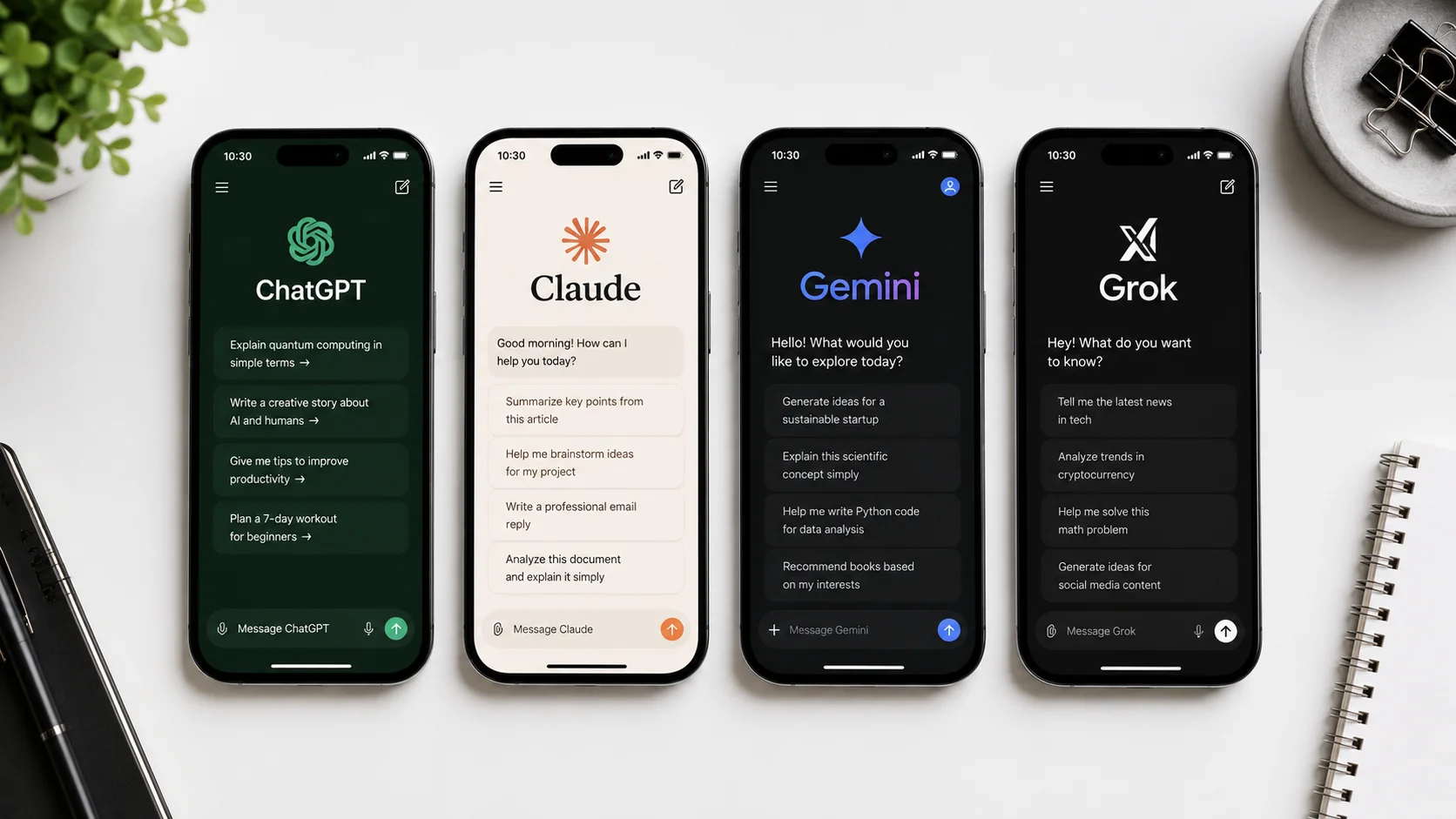
People ask me which AI chatbot is best almost more than any other tech question right now. And my honest answer — the one that frustrates people who want a simple winner — is that it depends entirely on what you're trying to do. Not because I'm dodging the question, but because in 2026 the four major chatbots have genuinely diverged. They don't have the same strengths. Picking the "best" without specifying the task is like asking which is better, a hammer or a screwdriver.
That said, I've been using all four heavily across a range of real tasks — writing, coding, research, document analysis, casual use — and I do have clear opinions about when each one wins and where each one disappoints. Here is the most direct comparison I can give you.
Why Comparing AI Chatbots in 2026 Is Harder Than It Looks
The gap between the top models has narrowed significantly over the past 18 months. In 2024, ChatGPT had a noticeable lead in most benchmarks. By mid-2026, the performance differences on standard tasks are small enough that they often don't matter in practice. What differentiates the chatbots more meaningfully now is their ecosystem, their design philosophy, and the specific domains where each one has been pushed hardest.
Context also matters: a task that one chatbot handles well in one context might fall apart when you add constraints. Nuanced writing in a specific voice, code debugging with unusual error messages, research questions with contested information — these are where the real differences show up, not in simple "explain X" prompts where all four perform adequately.
So the framework I'd suggest is this: instead of asking "which is best overall," ask "which is best for my most common tasks." That question has a cleaner answer.
ChatGPT (GPT-4o): Still the Most Versatile, Still the Most Popular
ChatGPT's biggest strength is breadth. It does a competent-to-good job at almost everything — coding, writing, summarization, image generation, voice conversation, browsing, data analysis with its code interpreter. No other chatbot has the same surface area of features in a single product. If you want one tool that handles the full range of tasks without switching between apps, ChatGPT Plus ($20/month) is still the most defensible choice.
The image generation integration is genuinely good — DALL-E 3 inside the chat interface means you can iterate on visuals within the same conversation where you're developing the concept. The voice mode is the best of any chatbot right now for natural back-and-forth conversation; it handles interruptions, processes tone, and feels substantially more like talking to a person than any competitor. GPT-4o's multimodal capabilities (processing images, PDFs, documents alongside text) are mature and reliable.
Where it falls short: ChatGPT tends to be aggressively agreeable. It will often validate a flawed argument rather than push back, produce pleasantly worded output that sounds confident but is factually thin, and hedge in ways that make responses feel polished but not always truthful. On complex writing tasks — long-form essays, anything requiring a distinct voice or genuine opinion — it produces work that reads as "AI-generated" more readily than Claude does. (If you need a dedicated prose generator, consider using the best AI writing tools instead). The free tier is now reasonably capable with GPT-4o mini, but the meaningful features (image generation, advanced data analysis, browsing) require Plus.
Claude (Anthropic): The One I Reach for When Writing or Analysis Matters
I'll be upfront: I use Claude more than any other chatbot for my own work. That's not a universal recommendation — it reflects my specific use cases — but I want to explain why clearly.
Claude is better at writing than any other chatbot right now, and it's not particularly close. The output has a quality I can only describe as more considered — it doesn't rush to fill words, it doesn't repeat itself, it doesn't use the same sentence constructions throughout a long piece. When I give it a writing task with a specific voice or tone requirement, it holds that voice throughout in a way that ChatGPT doesn't consistently manage. For anything where the writing quality matters — a proposal, a difficult email, a long-form piece of content — Claude is where I start.
The long context window is also genuinely useful. I regularly paste 50-80 page documents into Claude and ask detailed questions about specific sections. The comprehension is strong, the references back to the source material are accurate, and it's honest when something isn't clearly addressed in the document. That last part matters: Claude is more willing than ChatGPT to say "I'm not certain" or "the document doesn't directly address that" rather than generating a plausible-sounding but unsupported answer.
The limitations are real, though. Claude has no image generation, no voice mode, and doesn't browse the web in real time (without specific tool integrations). If you need to generate visuals, have a voice conversation, or get current news, you need a different tool. The free tier is also more restricted than ChatGPT's free offering. Claude Pro at $20/month unlocks the full model and higher usage limits, but for casual or occasional use, the free tier caps out faster than you might expect.
Google Gemini: The Best Choice If You Live in Google's Ecosystem
Gemini's headline differentiator in 2026 is Google Workspace integration, and for people who spend their working day in Google Docs, Gmail, Drive, and Calendar, this integration is legitimately useful. Gemini can summarize an email thread, draft a reply in your voice, help you rewrite a section of a Google Doc without leaving it, and pull context from your calendar when helping you plan. If that sounds like your workflow, the $20/month Gemini Advanced plan is genuinely worth considering.
As a standalone chatbot, Gemini 1.5 Pro is competitive in most benchmarks — particularly strong on factual questions where it can leverage Google's search infrastructure for grounding. Real-time information access is baked in, not a feature you have to toggle, which is an advantage over Claude and works better than ChatGPT's browsing in my experience. For research tasks where you need current information and don't want to fact-check against a knowledge cutoff, Gemini is a solid choice.
The weakness is nuance and depth on complex tasks. Gemini handles broad factual questions well but struggles with the kind of subtle analysis or sophisticated writing that Claude handles better. Code generation is decent but not as reliable as ChatGPT or Copilot-assisted tools for complex debugging. And outside of the Google Workspace integration, the reason to choose Gemini over ChatGPT or Claude is less clear. It's a good option — it's not a standout one unless you're already embedded in Google's tools.
Grok (xAI): The Wildcard With Real-Time X Data Access
Grok is genuinely different from the other three, and I mean that in a specific, limited way. Its unique value proposition is real-time access to X (formerly Twitter) data — posts, trending topics, breaking news as it happens on the platform. No other major chatbot has this. If your use case involves tracking what people are saying about something right now — a brand, a news event, a public figure, a market trend — Grok is the only tool that can actually do that from within a chat interface.
For everything else, the picture is more complicated. Grok 3, released in early 2026, is a genuine improvement over previous versions — competitive on coding benchmarks, and the "fun mode" has made it popular for casual conversation where users want less filtered, more direct responses. But it also means Grok is more likely to produce content that other chatbots would decline, which some users want and others find inconsistent.
The practical limitations are significant. Grok is only available as part of an X Premium subscription ($8-16/month depending on tier), which means you're paying for an X subscription to access the AI — not the other way around. If you're already an X Premium subscriber, Grok is a free bonus that's worth using for real-time social data. If you'd be subscribing solely to get Grok, the math doesn't favor it unless the real-time X data is genuinely central to your use case. General writing, analysis, and coding tasks are all handled better by ChatGPT or Claude at similar or lower prices.
The Honest Verdict: Which AI Chatbot to Use for Which Task
Rather than declaring a winner, here is how I actually route tasks across these four tools:
Writing anything important — a proposal, a long-form article, a tricky email, anything where the quality of the prose matters — I use Claude. The writing is consistently better, and it pushes back when something doesn't make sense rather than just executing the instruction.
Coding and debugging — ChatGPT with the code interpreter, or Claude for complex architecture conversations. Both are strong; ChatGPT's ability to run code in the sandbox and show output is useful for data work, scripting tasks, or finding ways to earn money with AI.
Research with a knowledge cutoff requirement — Gemini, because the real-time search grounding is built in and reliable. For anything where "as of today" matters, Gemini is the cleanest choice.
Real-time social/news monitoring — Grok is the only tool with direct X data access. For this specific task, there's no real competition.
Voice conversation — ChatGPT, which has by far the most natural and capable voice mode of any of these tools.
If you can only choose one: ChatGPT Plus at $20/month covers the most ground. But if writing quality matters more to you than feature breadth, Claude Pro is the stronger choice for that $20. The honest answer is that most people who use AI heavily end up with access to two of these, not one — and that's not a failing of the tools, it's a reflection of how different the use cases actually are.
What I'd avoid is treating this as a one-time decision. The landscape moves fast enough that a tool that lags in one area today may lead in it six months from now. The more important skill is developing a clear sense of what you're actually trying to accomplish with each prompt — and being willing to switch tools when the task demands it.