

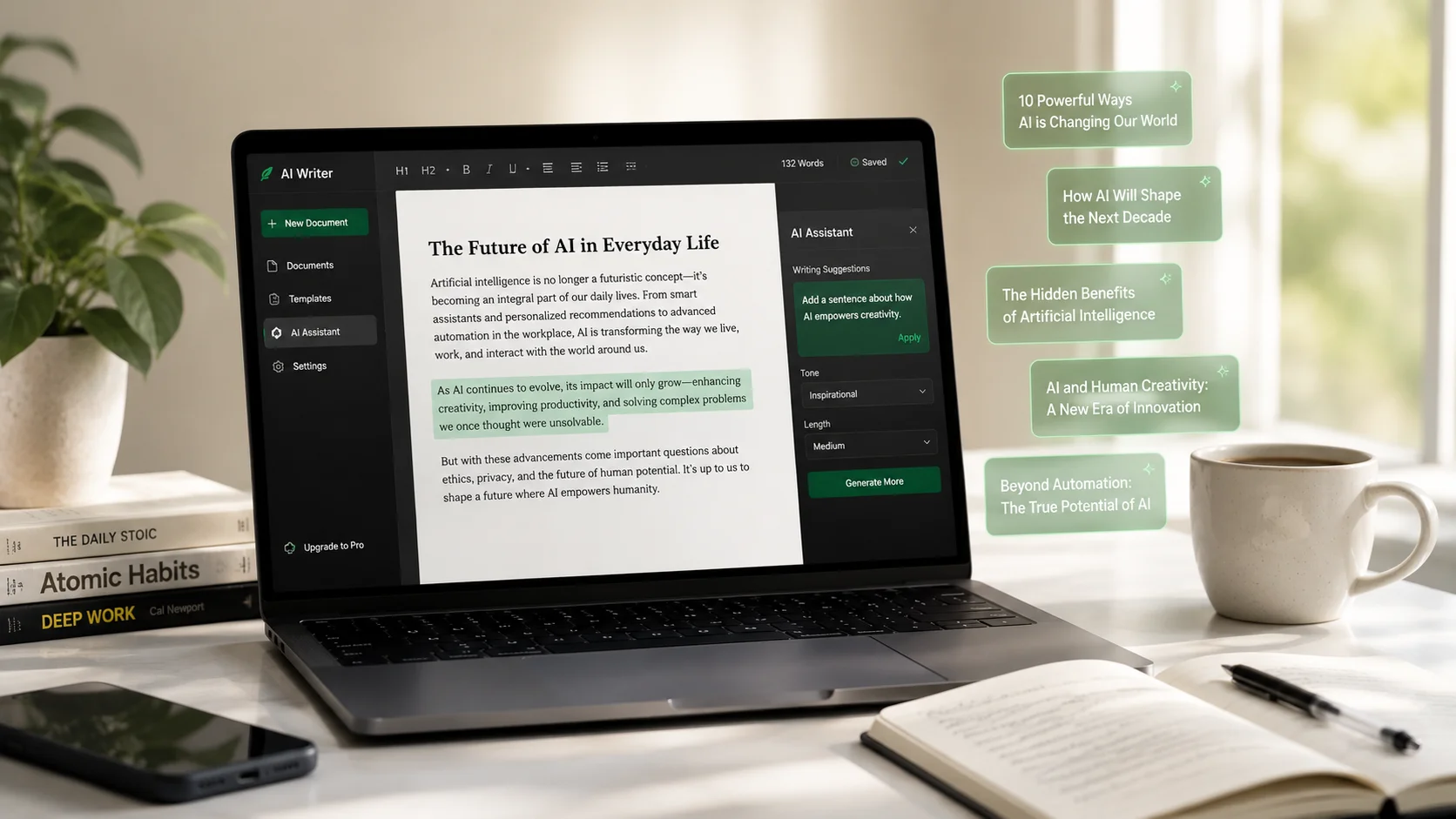
The AI Writing Tool Problem: Everyone Promises Quality, Few Deliver Consistently
Every AI writing tool on the market promises the same thing: better content, faster, with less effort. The marketing copy is almost interchangeable — "generate blog posts in seconds," "10x your content output," "write like a pro." I've tested enough of these platforms to know that the gap between the promise and the actual experience ranges from narrow to enormous depending on the use case.
The honest framing is this: AI writing tools have gotten genuinely good at certain tasks and remain genuinely mediocre at others. Short-form copy — email subject lines, ad headlines, product descriptions, social captions — is an area where these tools can match or exceed what a human writer produces in the same time frame. Long-form content — a 2,000-word blog post that takes a nuanced position, draws on real experience, and reads like it was written by a person with actual opinions — is much harder, and the tools that claim to nail it are usually producing technically correct but distinctly hollow text.
The right mental model isn't "AI writes my content." It's "AI dramatically reduces the time I spend on specific parts of the content creation process." The tools that understand this and build around it are the ones worth paying for. The ones that promise to replace the writer entirely are mostly selling you something that won't survive a reader's second paragraph without revealing its seams.
With that framing established, here's what I actually found when I put seven of the most-used platforms through real work — not benchmark prompts, but actual marketing tasks across different content types and industries.
Jasper AI: Still the Enterprise Standard but Priced for Enterprise Budgets
Jasper has been the flagship AI writing platform for enterprise marketing teams for several years, and in 2026 it remains in that position — but it's becoming increasingly hard to justify for anyone who isn't operating at enterprise scale. The Creator plan is $49/month per seat. The Pro plan, which adds multi-user support and brand voice features, starts at $69/month per seat. Team pricing gets you to $99/month for five users. That is a meaningful monthly expense, and it matters because the underlying AI models powering Jasper — GPT-4 and Claude, depending on the task — are the same ones available directly from OpenAI and Anthropic at a fraction of the cost.
What Jasper adds on top of those models is where the real value lives. The Brand Voice feature is legitimately useful: you feed Jasper examples of your existing content, and it learns to write in that voice consistently — the cadence, the level of formality, the characteristic phrasing. For a marketing team producing high volumes of content that needs to stay on-brand, this is a real differentiator. The template library covers over 50 specific use case formats, from Amazon product descriptions to AIDA-framework marketing emails to SEO blog outlines. These aren't generic templates — they're structured prompts that guide the model toward outputs appropriate for each format.
The SEO integration with Surfer SEO (available on higher plans) is the other piece that justifies enterprise spending. As you write or generate a blog post, Surfer's keyword optimization overlay shows you in real time which terms to include, what content depth competitors are hitting, and where your current draft falls short. For content teams whose primary KPI is organic traffic, that real-time feedback loop reduces the back-and-forth between writer and SEO analyst significantly.
If you're a solo creator or small business, Jasper is hard to recommend at its current pricing. You're paying a significant premium for brand voice and workflow features you can largely replicate with careful prompting in a general-purpose AI tool. But for a team producing 20+ pieces of content monthly across multiple channels with a defined brand identity, Jasper's infrastructure genuinely earns its cost.
Copy.ai: Best for Short-Form and Ad Copy
Copy.ai found its lane early and has stayed in it: short-form copy where speed and variation matter more than depth. If you need ten variations of a Facebook ad headline, five angles for an email subject line test, or a product description rewritten in three different tones, Copy.ai is fast, capable, and cheaper than Jasper for this specific use case. The free plan gives you a meaningful number of monthly runs to evaluate it properly; the Pro plan is $36/month, which is more accessible than Jasper's entry point.
The workflow is built around use case templates. You select the content type — email subject line, Google ad headline, Instagram caption, AIDA copy, PAS framework copy, product description — fill in the context fields (product name, key benefit, target audience, tone), and generate a batch of variations. The best practice is to generate 5–10 options per template and cherry-pick or combine the strongest elements. Copy.ai rarely produces a perfect output on a single attempt, but the variation engine makes iteration fast.
For Facebook and Instagram ad copy specifically, the platform performs above average. It understands the structural conventions of direct response copy — hook, problem identification, solution framing, call to action — and the shorter format plays to the model's strengths. Email subject lines are another genuine strength: give it your email's topic, the desired emotional register (curiosity, urgency, benefit-driven), and a target character count, and the outputs are usually worth testing.
Where Copy.ai falls short is anything requiring research, a sustained argument, or genuine subject matter expertise. The long-form blog post generator produces plausible-sounding content that lacks the specific detail that makes content actually useful to a reader. Treat it as a short-form and ideation tool, not a full content solution, and it's good value.
Writesonic: The Best Balance of Quality and Price for Individuals
If I had to pick one AI writing tool for a solo creator, freelancer, or small business owner who produces a range of content types, Writesonic would be it. The value-to-price ratio is stronger than any other tool in the space right now. The Individual plan is $20/month and includes unlimited generations using GPT-4o — not a limited GPT-4 access that throttles after a certain word count, but genuinely unlimited. The Freelancer plan at $20/month (yes, the same price point with slightly different feature balance) is worth comparing directly when you sign up.
The Article Writer 6.0, Writesonic's flagship long-form feature, is the closest any dedicated AI writing tool gets to producing blog post drafts that don't immediately read as AI-generated. The workflow asks you to input your target keyword, select from generated title options, approve an outline, and then generates a full article section by section. The output isn't publish-ready — no AI long-form output should go to publish without human editing — but it's structurally sound, covers the topic with reasonable depth, and maintains a consistent tone throughout.
The Chatsonic feature, Writesonic's conversational interface, has web browsing capability built in, which means it can reference current information rather than relying entirely on training data. For content that benefits from current stats, recent news, or up-to-date pricing information, this matters. The browsing integration is more reliable in Writesonic than in some competitors, where web-grounded generation can produce hallucinated citations that sound authoritative but link to nothing real.
The one area where Writesonic's lower price shows: brand voice consistency across multiple sessions. Unlike Jasper, there's no robust brand voice training system. Each session, you're essentially re-prompting your tone preferences. For occasional use, this is fine. For teams producing high volumes of content under a strict brand identity, it creates friction.
Claude and ChatGPT as Writing Assistants: When the General Tools Win
Here's the uncomfortable truth the dedicated AI writing tool companies would prefer you didn't sit with: for a large proportion of writing tasks, Claude and ChatGPT — the general-purpose AI assistants — produce better outputs than purpose-built writing tools, at lower cost, with more flexibility.
Claude (the AI behind Claude.ai) is particularly strong for long-form content. Give it a detailed brief — target audience, key points to cover, tone, length, SEO keyword to work in naturally — and the first draft it produces has noticeably more coherent structure and more natural prose than what Jasper or Copy.ai generate on the same brief. Claude seems to understand nuance in a way that dedicated writing tools, which are essentially structured prompt wrappers around similar underlying models, don't consistently replicate.
ChatGPT's strength is iteration and editing. Paste in a draft you've written and ask it to tighten the opening paragraph, punch up the call to action, rewrite a section at a lower reading level, or suggest three alternative angles for the conclusion. The back-and-forth conversational editing workflow is where ChatGPT genuinely shines. It also handles fact-checking prompts well — ask it what claims in your draft it can't verify and it'll flag the uncertain ones, which is a useful quality control step before publishing.
The practical advice: use Claude or ChatGPT Plus ($20/month each) as your primary writing assistant for drafting and editing, and reach for a dedicated tool like Copy.ai or Writesonic when you need the structured templates and batch variation features that general-purpose tools don't surface as intuitively. Many content creators I know run both: a general-purpose AI for thinking and drafting, a specialized tool for specific copy formats at scale.
The Workflow That Actually Works: AI Writes the Draft, Human Refines the Voice
After working with all of these tools across real content projects, one thing is clear: the people getting the most value from AI writing tools are the ones who've stopped trying to use them as a replacement for their writing and started using them as a replacement for the blank page.
The blank page problem is where most of us lose time. Staring at an empty document, trying to formulate an opening, restructuring an outline for the third time, circling around a topic without committing to a direction — that's where hours disappear. AI is extremely good at eliminating that problem. Give it a topic and a rough direction and it will give you something to react to. The first draft doesn't need to be good. It needs to exist so you have something to push against.
The workflow that consistently produces the best results looks like this: brief the AI with specificity (not "write a blog post about AI writing tools" but "write a 1,500-word post for a marketing professional audience arguing that AI writing tools work best as draft generators rather than final copy machines — cover Jasper, Copy.ai, and Writesonic with specific pricing"), generate a full draft, then spend 30–45 minutes editing — cutting what's generic, rewriting what sounds hollow, injecting specific examples from your own experience, and adjusting the voice until it sounds like you. The result is content that would have taken 3–4 hours to write from scratch, produced in about 90 minutes total. That's the real number when you account for the editing that good AI-assisted content requires.
The tools that best support this workflow are Writesonic for the initial long-form draft, Claude for the rewriting and refinement passes, and Copy.ai when you need to generate a batch of short-form assets from the same underlying content — pulling email subject lines, social captions, and ad hooks from a post you've already polished. That stack costs roughly $55/month combined and covers every content creation scenario most marketers and creators will encounter.