

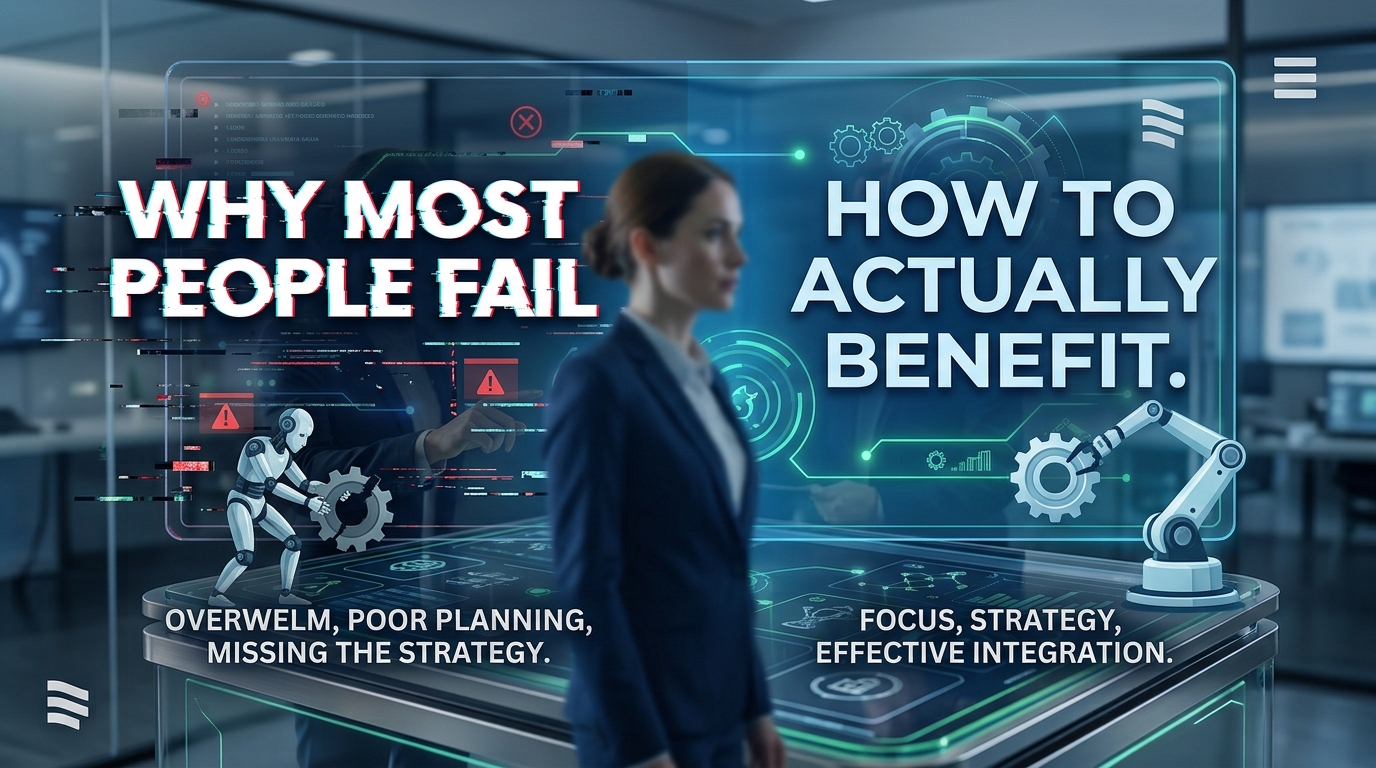
Artificial intelligence is everywhere. Every day, a new AI tool promises to save hours of work, generate incredible content, or completely transform the way we do business. Social media is filled with screenshots of people claiming they built successful businesses overnight using AI.
After seeing enough of these stories, it's easy to believe that all you need is access to the latest AI platform and success will follow automatically. But reality tells a very different story. Most people who start using AI never experience meaningful results. Not because AI doesn't work. Because they use it the wrong way.
The Biggest Misunderstanding About AI
One of the biggest misconceptions is that AI is a replacement for knowledge, creativity, or experience. It isn't. AI is an amplifier. If you already understand your industry, your customers, and the problems you're trying to solve, AI can dramatically increase your speed and productivity. If you have no direction, AI simply helps you move faster in the wrong direction.
That is why two people can use exactly the same AI tool and achieve completely different outcomes. The difference is rarely the software. The difference is the person behind it.
The Tool Is Not the Competitive Advantage
Every few days, a new AI application goes viral. People rush to try it. Videos appear claiming it will replace jobs or make thousands of dollars every month. A few weeks later, everyone moves on to the next tool. The cycle repeats itself.
Meanwhile, the people who consistently benefit from AI are often using the same handful of tools they adopted months ago. They are not chasing every new release. They are improving their workflows. Technology changes quickly. Good systems last much longer.
AI Rewards People Who Take Action
Many people spend hours watching YouTube videos about AI. They subscribe to newsletters. They save dozens of AI websites. They bookmark hundreds of tools. But they rarely build anything. Knowledge without action creates nothing. Someone using a simple AI assistant every day will usually outperform someone who knows about every AI tool but never applies them. Progress comes from implementation, not information.
Stop Looking for the Perfect AI Tool
One of the easiest ways to waste time is constantly searching for better software. There will always be another chatbot, another image generator, another automation platform, another writing assistant.
Instead of asking, "What is the best AI tool?" start asking a different question: "What problem am I trying to solve?" That small shift completely changes how you use AI. When the focus moves from software to solving problems, AI becomes far more valuable.
Small Improvements Create Massive Results
Most people expect AI to transform their work overnight. That almost never happens. The real value comes from making small improvements every single day. Saving ten minutes writing emails. Reducing research time by thirty minutes. Creating content twice as fast. Automating repetitive administrative tasks.
Each improvement seems small on its own. Over weeks and months, those gains compound into hundreds of saved hours. That is where AI becomes truly powerful.
AI Will Not Replace Curiosity
One quality still separates successful people from everyone else: curiosity. People who ask better questions get better answers. They experiment. They test ideas. They learn from failures. AI cannot replace curiosity. It rewards it. The more willing you are to explore, question, and improve, the more valuable AI becomes. The technology is available to everyone. Curiosity is not.
Learn Principles Before Platforms
Every year, new AI companies appear while others disappear. Specific tools will change. The principles behind them will not. Learn how to:
- Write effective prompts.
- Verify AI generated information.
- Build repeatable workflows.
- Automate repetitive tasks.
- Think critically about AI outputs.
These skills will remain valuable regardless of which platform becomes popular next year. People who understand principles adapt much faster than people who only learn software.
AI Is Not Here to Replace You
One of the biggest fears surrounding artificial intelligence is job replacement. Every week there seems to be another headline claiming AI will eliminate entire professions. While AI is certainly changing the way we work, the reality is far more nuanced.
Most jobs are made up of dozens of different tasks. AI is excellent at handling repetitive, predictable, and time consuming work. It is far less capable when it comes to creativity, leadership, empathy, critical thinking, and building relationships. That means AI is not replacing people. It is changing which skills are the most valuable. Those who learn to combine their expertise with AI will have a significant advantage over those who ignore it.
Your Mindset Matters More Than the Technology
Some people see AI as a threat. Others see it as an opportunity. The technology is exactly the same. The difference lies in perspective. Throughout history, every major technological shift has created uncertainty. The internet changed business. Smartphones changed communication. Cloud computing changed software. Artificial intelligence is following the same pattern. Those who adapt early often benefit the most. Those who resist change usually find themselves trying to catch up later.
Start With One Problem
You do not need to redesign your entire workflow overnight. In fact, trying to automate everything at once usually leads to frustration. Instead, identify one task that you repeat every day. Maybe it is answering emails, writing reports, planning social media posts, researching information, or organizing meeting notes. Choose one problem and explore how AI can help solve it. Once that becomes part of your routine, move on to the next task. Small improvements are much easier to sustain than dramatic changes.
Consistency Beats Complexity
Many people spend more time searching for new AI tools than actually using the ones they already have. They jump from one platform to another hoping to find the perfect solution. In reality, the most productive people usually rely on a small collection of trusted tools that fit naturally into their workflow. They understand that consistent execution beats constantly chasing the latest trend. The goal is not to use the most AI tools. The goal is to become better at your work.
The Real Competitive Advantage
Artificial intelligence is becoming widely available. Almost everyone has access to powerful AI assistants. That means the technology itself is no longer the advantage. The advantage comes from knowing how to ask better questions, make better decisions, and apply AI in ways that create real value. Businesses do not pay for prompts. Customers do not pay for automation. People pay for solutions. AI simply helps you deliver those solutions faster.
Final Thoughts
Artificial intelligence is one of the most powerful technologies of our generation. But its greatest strength is not replacing human intelligence. It is amplifying it. The people who benefit the most from AI are not necessarily programmers or technology experts. They are curious learners who continuously improve their skills, experiment with new ideas, and focus on solving real problems.
If you stop chasing every new AI tool and start building better habits, you'll discover that AI becomes less of a distraction and more of a genuine competitive advantage. The future belongs to people who know how to combine human creativity with artificial intelligence.
🎁 Get Your Free AI Prompt Guide
Stop guessing what to type. Download our free guide with 50+ proven prompts for productivity, writing, research, and business automation — ready to copy and use today.
Join 5000+ creators. No spam. Unsubscribe anytime.
Frequently Asked Questions
Why do many people fail to benefit from AI?
Most people focus on finding the newest tools instead of solving real problems. AI delivers the best results when it becomes part of a consistent workflow.
Do I need technical skills to use AI effectively?
No. Most modern AI platforms are designed for everyday users. The most important skill is learning how to communicate clearly with AI and apply its output effectively.
Will AI replace every job?
No. AI is changing how work is done by automating repetitive tasks, but human creativity, judgment, communication, and leadership remain essential.
How should beginners start using AI?
Start with one repetitive task in your daily work. Learn how AI can help with that specific activity before expanding to other areas.